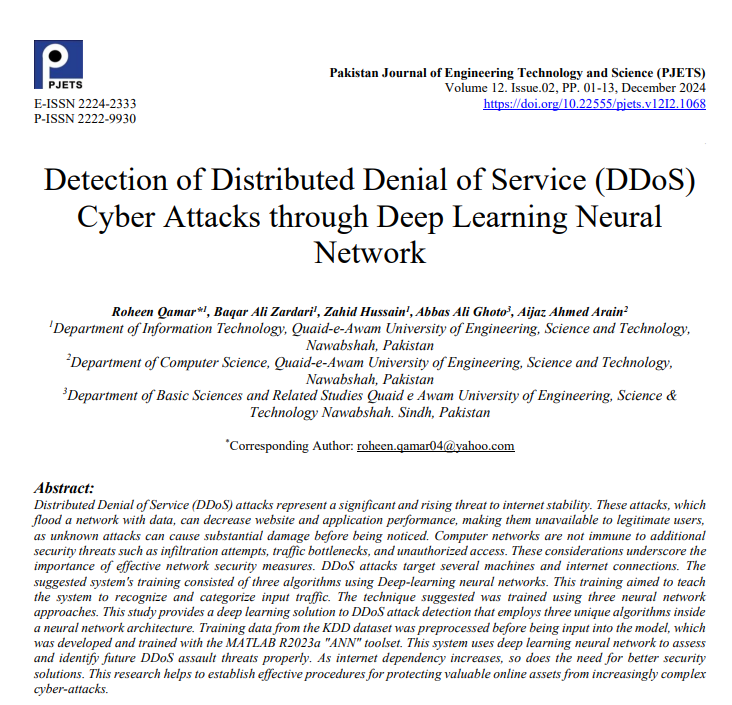
Detection of Distributed Denial of Service (DDoS) Cyber Attacks through Deep Learning Neural Network
DOI:
https://doi.org/10.22555/pjets.v12i2.1068Keywords:
DDoS, Deep Learning Neural Network (DLN), Naive Bayes Training Algorithm, K-Nearest Neighbor (KNN) Training Algorithm, Semi-Supervised K-Means Clustering Algorithm.Abstract
Distributed Denial of Service (DDoS) attacks pose a significant and escalating threat to online stability. By flooding a network with overwhelming traffic, these attacks can cripple website and application performance, making them inaccessible to legitimate users. Their insidious nature adds to the danger, as undetected attacks can cause considerable damage before being brought to light. Computer networks are not immune to other security vulnerabilities, facing challenges like intrusion attempts, traffic congestion, and unauthorized access. These concerns highlight the crucial role of robust network security measures. This research proposes a deep learning approach to DDoS attack detection using three distinct algorithms within a neural network framework. Training data from the KDD dataset was preprocessed and fed into the model, built and trained using the MATLAB R2023a "ANN" toolkit. This system leverages the capabilities of autoencoders and deep learning to effectively analyze and identify potential DDoS attacks. As internet reliance continues to grow, so does the urgency for advanced security solutions. This research contributes to the development of effective mechanisms for safeguarding valuable online assets from increasingly sophisticated cyber threats.
References
Downloads
Published
Issue
Section
License
Copyright (c) 2024 Roheen Qamar, Baqar Ali Zardari, Zahid Hussain, Abbas Ali Ghoto, Aijaz Ahmed Arain

This work is licensed under a Creative Commons Attribution 4.0 International License.