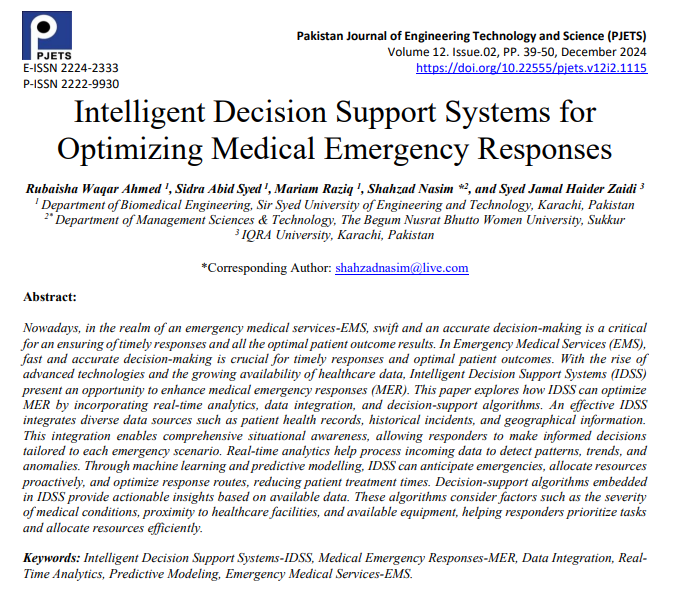
Intelligent Decision Support Systems for Optimizing Medical Emergency Responses
DOI:
https://doi.org/10.22555/pjets.v12i2.1115Keywords:
: Intelligent decision support systems-IDSS, Medical emergency responses-MER, Data integration, Real-time analytic, Predictive modeling, Emergency medical services-EMS.Abstract
Now-a-days, in the realm of an emergency medical services-EMS, the swift and an accurate decision-making is a critical for an ensuring of timely responses and all the optimal patient outcome results. With a heavy advent of an advanced techniques and these proliferation of the data sources in the healthcare, there is a high-level growing opportunity of an Intelligent decision supporting systems-IDSS to enhance an efficiency and an effectiveness of the medical emergency responses-MER widely. This study paper explores the role of an intelligent-DDS in the optimization of the medical emergency responses through analyzing various aspects factors like of the real-time analytic, data integration, and the decision supporting-algorithms. First of all, the integration of the diverse data-sources likewise patients healthcare records, some historical incidents, and the geo-graphical information all forms the foundation of an effective IDSS. The amalgamation of the data streaming generated by an IDSS can be comprehensive awareness, enabling the res-ponders to make an informed-decision tailored to any specific needs in each emergency scenarios. Then, the real-time analytic plays a pivotal role in the interpretations and processing of an incoming data-sets to detect the patterns, trends, and the anomalies. With the help of these techniques like machine-learning as well predictive-modeling, an IDSS can simply anticipate the potential emergency, pro-actively allocated the resources, and optimized response routes too in an-order-to minimize the time-to treatments of the patients globally. Furthermore, decision-support algorithms embedded within IDSS provide respondents with an actionable insights and recommendations based-on analysis of available data-sets. These powerful IDSS algorithms considered factors like severity of medical conditions, proximity to the health-care facilities, and as well the availability of specialized equipment to guide respondent in prioritizing tasks and allocating resources efficiently and enhancing over-all systems resilience. [1-3]
References
Downloads
Published
Issue
Section
License
Copyright (c) 2024 Rubaisha Waqar Ahmed, Sidra Abid Syed, Mariam Raziq, Shahzad Nasim, Syed Jamal Haider Zaidi

This work is licensed under a Creative Commons Attribution 4.0 International License.