Exploring Fish Species Exploring Fish Species Classification using Deep Learning
Fish Species Classification using Deep Learning
DOI:
https://doi.org/10.22555/pjets.v12i2.1120Keywords:
Fish species classification; Convolutional Neural Network (CNN); VGG16; Rest Net 50; Deep learningAbstract
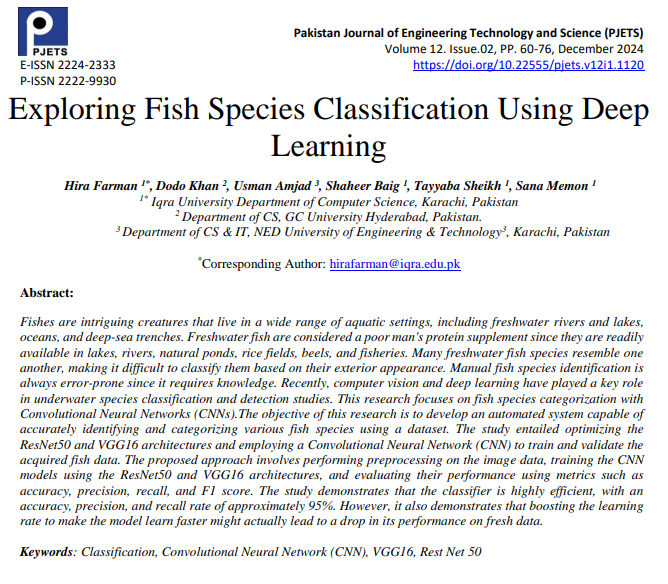
Fishes are intriguing creatures that live in a wide range of aquatic settings, including freshwater rivers and lakes, oceans, and deep-sea trenches. Freshwater fish are considered a poor man's protein supplement since they are readily available in lakes, rivers, natural ponds, rice fields, beels, and fisheries. Many freshwater fish species resemble one another, making it difficult to classify them based on their exterior appearance. Manual fish species identification is always error-prone since it requires knowledge. Recently, computer vision and deep learning have played a key role in underwater species classification and detection studies. This research focuses on fish species categorization with Convolutional Neural Networks (CNNs) and two popular architectures, ResNet50 and VGG16. The goal of this research is to create an automated system that can correctly recognize and classify different fish species based on dataset. The two architecture ResNet50 and VGG16 are fine-tuned and CNN for training and validation of the collected fish data. The suggested method entails preprocessing the image data, training the CNN models with ResNet50 and VGG16 architectures, and assessing their performance using measures such as accuracy, precision, recall, and F1 score. This study reports the best overall classification accuracy, precision, and recall rate, which is almost 95%. Comprehensive empirical investigation has proven that when the weight and bias learning rate increases, so does the classifier's validation loss.
References
Downloads
Published
Issue
Section
License
Copyright (c) 2024 Hira Farman Ali Baig, Dodo Khan, Usman Amjad, Shaheer Baig, Tayyaba Sheikh, Sana Memon

This work is licensed under a Creative Commons Attribution 4.0 International License.