Comparative Analysis of Hybrid Attention and Progressive Layering Through a Comprehensive Evaluation of ARU-Net and PLU-Net in Brain Tumour Segmentation
DOI:
https://doi.org/10.22555/pjets.v13i1.1371Keywords:
brain tumour segmentation, deep learning, magnetic resonance imaging, convolutional neural networks, hybrid attention, progressive learning modelAbstract
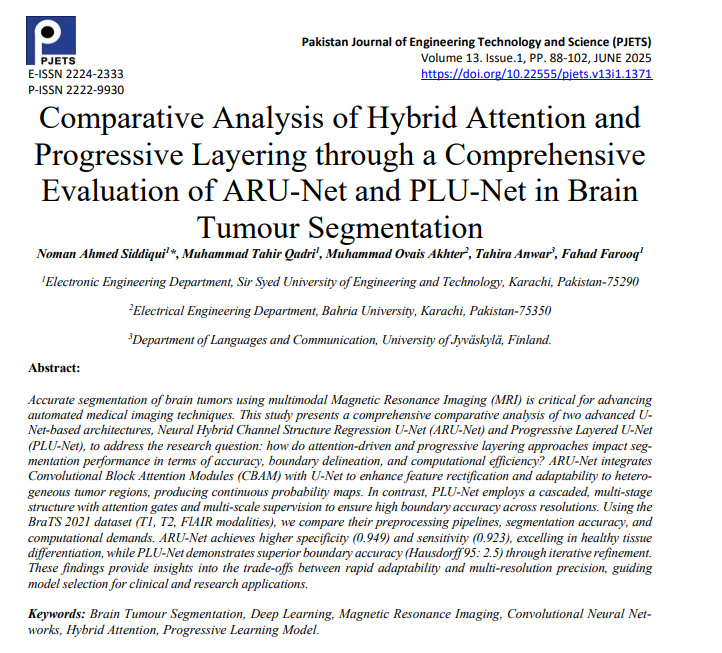
The spectral separation of brain tumour using multimodal Magnetic Resonance Imaging (MRI) is a crucial but laborious undertaking in the field of medical imaging and suggests advanced procedures of automated models in order to mitigate the limitation of manual marking. The current study is an in-depth comparative study of two different deep-learning models the Novel Hybrid Channel Attention Regression U-Net (ARU-Net) and Progressive Layered U-Net (PLU-Net) that build on the U-Net architecture as an enhancement to increase the segmentation accuracy of the BraTS 2021 dataset with respect to the T1, T1ce, T2, and FLAIR modalities. ARU-Net mainly uses the methods of integrating the Convolutional Block Attention Modules (CBAM) and Squeeze-and-Excitation (SE) blocks, adding a regression-based output layer to generate continuous probability maps, which further focuses on feature recalibration and heterogeneity adaptation to tumour regions. On the other hand, PLU-Net uses a cascaded, multi-stage structure enhanced by attention gates and multi-scale data augmentation where the main emphasis is a progressive boosting of accuracy levels at multiple resolutions to guarantee high boundary accuracy. The preprocessing steps are quite different as ARU-Net uses simplified Z-score normalisation and resizing, and PLU-Net involves a full pipeline, involving skull stripping, bias field correction, and two normalisations. The performance analysis reveals that augmentation makes ARU-Net perform better in the specificity (0.949), sensitivity (0.921), and overall accuracy (0.94), and that the overall Dice coefficient (0.91) and Hausdorff95 (2.5) are superior to those of the PLU-Net, which signifies the efficiency of its iterative refinement. Graphical representations of different measures like Dice, specificity and sensitivity validate the fact that ARU-Net excels in terms of healthy-tissue differentiation and that PLU-Net is accurate in the delineation of tumour core. Taken together, the findings open up the synergistic properties of both ARU-Net in terms of its lightweight, attention-driven focus and PLU-Net in terms of its detailed, multi-stage processing on modern hierarchical segmentation paradigms. The presentation of this comparative analysis will not only provide methodological contributions to each of the models, but it will also offer future directions in the development of clinically viable brain tumour segmentation with an aim of finding a balance between efficiency and accuracy in order to support diagnosis.
References
Downloads
Published
Issue
Section
License
Copyright (c) 2025 Pakistan Journal of Engineering, Technology and Science

This work is licensed under a Creative Commons Attribution 4.0 International License.