MobileNetV1-Inspired Deep Learning Framework for Early Detection and Staging of Alzheimer’s Disease Using MRI
DOI:
https://doi.org/10.22555/pjets.v13i2.1458Keywords:
Alzheimer’s, MRI, CNN, MobileNet v1, deep learning, medical imagingAbstract
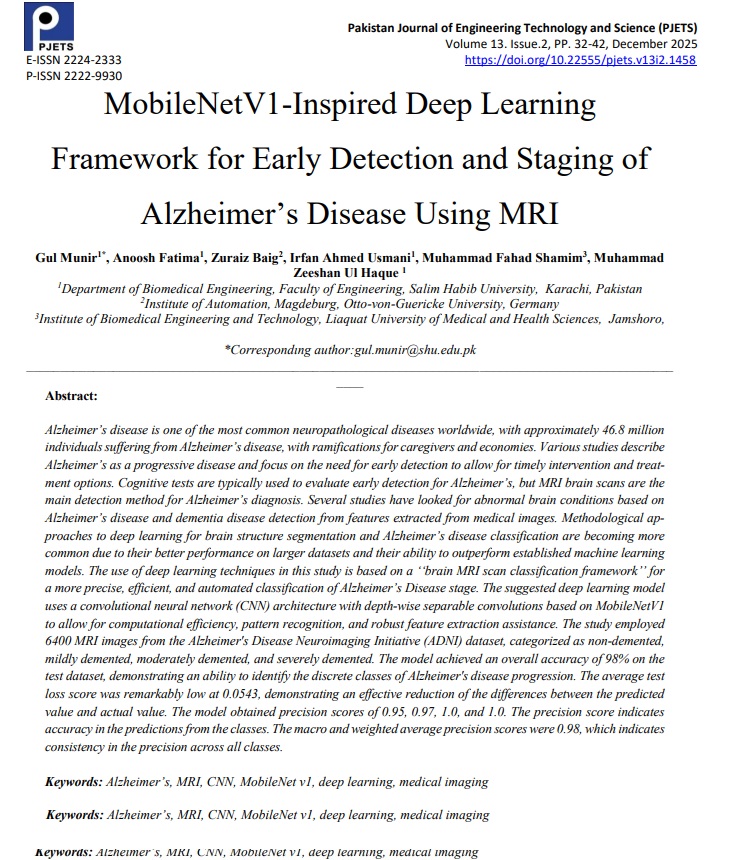
Alzheimer’s disease is one of the most common neuropathological diseases worldwide, with approximately 46.8 million individuals suffering from Alzheimer’s disease with ramifications for caregivers and economies. Various studies describe Alzheimer’s as a progressive disease and focus on the need for early detection to allow for timely intervention and treatment options. Cognitive tests are typically used to evaluate early detection for Alzheimer’s but MRI brain scans are the main detection method for Alzheimer’s diagnosis. Several studies have looked for abnormal brain conditions based on Alzheimer’s disease and dementia disease detection from features extracted from medical images. Methodological approaches to deep learning for brain structure segmentation and Alzheimer’s disease classification are going to become more common due to their better performance on larger datasets and outperforming established machine learning comprehension models. The use of deep learning techniques in this study is based on ‘‘brain MRI scan classification framework’’ for a more precise, efficient, and automated classification of Alzheimer’s Disease stage. The suggested deep learning model uses a convolutional neural network (CNN) architecture with depth-wise separable convolutions based on MobileNetV1 to allow for computational efficiency, pattern recognition and robust feature extraction assistance. The study employed 6400 MRI images from the Alzheimer's Disease Neuroimaging Initiative (ADNI) dataset, categorized as non-demented, mildly demented, moderately demented, and severely demented. The model achieved an overall accuracy of 98% on the test dataset, demonstrating an ability to identify the discrete classes of Alzheimer's disease progression. The average test loss score was remarkably low at 0.0543, demonstrating an effective reduction of the differences between the predicted value and actual value. The model obtained precision scores of 0.95, 0.97, 1.0, and 1.0. The precision score indicates accuracy in the predictions from the classes. The macro and weighted average precision scores were 0.98, which indicates consistency in the precision across all classes.
References
Downloads
Published
Issue
Section
License
Copyright (c) 2025 Pakistan Journal of Engineering, Technology and Science

This work is licensed under a Creative Commons Attribution 4.0 International License.