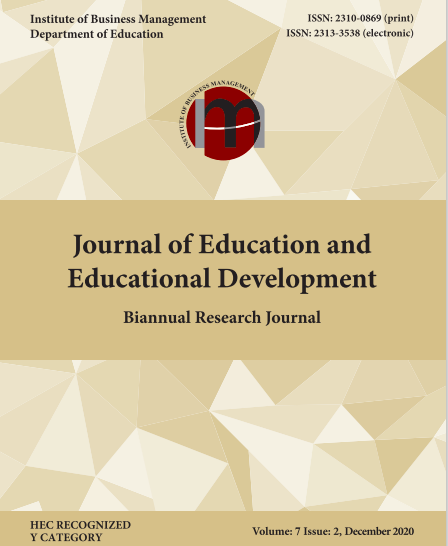
What Kind of Person Should an Education System Raise? A Survey of Teachers’ Views in Turkey
DOI:
https://doi.org/10.22555/joeed.v7i2.18Keywords:
education system, kind of person, phenomenology, teacher, school administratorAbstract
This study aims to find answers to the question: What kind of person should the Turkish education system raise? To evaluate the participants’ responses thoroughly, the phenomenology method has been used. The study group includes 185 teachers and school administrators working in Sivas city centre. To reach out to more participants, the data have been obtained by a survey developed by the researcher. Four categories, academic, social, individual, and ethical, have been identified as a result of data analysed with content analysis. The data have been presented according to the variables of school type and positions. According to the findings, it has been found out that teachers’ order of preference about the kind of person to be raised is individual, academic, ethical, and social characteristics;
administrators’ order of preference is academic, individual, ethical, and social characteristics. Sentences have been formed about the kind of a person to be raised by the variables of school types and positions in the study. In this regard, considering participants’ priorities, common phrases have been brought out to be ‘having critical thinking, ethical, national and moral values, and love of country and nation’.
References
Almonte, S. A. (2003). National identity in moral education textbooks for high school students in the Philippines: A content analysis. Asia Pacific Education Review, 4(1), 19-26.
Afonso, A. (2019). The emergence of accountability in the Portuguese education system. Euro-JCS, 1(2), 125-13.
Applebaum, B. (2005). In the name of morality: Moral responsibility, whiteness and social justice education. Journal of Moral Education, 34(3), 277-290.
Aron, L., & Loprest, P. (2012). Disability and the education system. The future of Children, 22(1), 97-122.
Barbour, M. (2009). Today’s student and virtual schooling: The reality, the challenges, the promise. Journal of Open, Flexible, and Distance Learning, 13(1), 5-25.
Bazhenov, R. I., & Luchaninov, D. V. (2014). Use of blended learning elements for formation of a humanitarian student’s creative initiative at learning modern information technologies. Life Science Journal, 11(11s), 371-37.
Beckmann, A., & Cooper, C. (2005). Conditions of domination: Reflections on harms generated by the British state education system. British Journal of Sociology of Education, 26(4), 475-489.
Biesta, G. (2009). Good education in an age of measurement: On the need to reconnect with the question of purpose in education. Educational Assessment, Evaluation and Accountability (formerly: Journal of Personnel Evaluation in Education), 21(1), 33-46.
Bitzer, E. (2005). First-year students' perceptions of generic skills competence and academic performance: A case study at one university. South African Journal of Higher Education, 19(3), 172-187.
Clouder, L. (2009). ‘Being responsible’: students’ perspectives on trust, risk and work-based learning. Teaching in Higher Education, 14(3), 289-301.
Downloads
Published
Issue
Section
License
Copyright (c) 2020 Journal of Education and Educational Development

This work is licensed under a Creative Commons Attribution 4.0 International License.