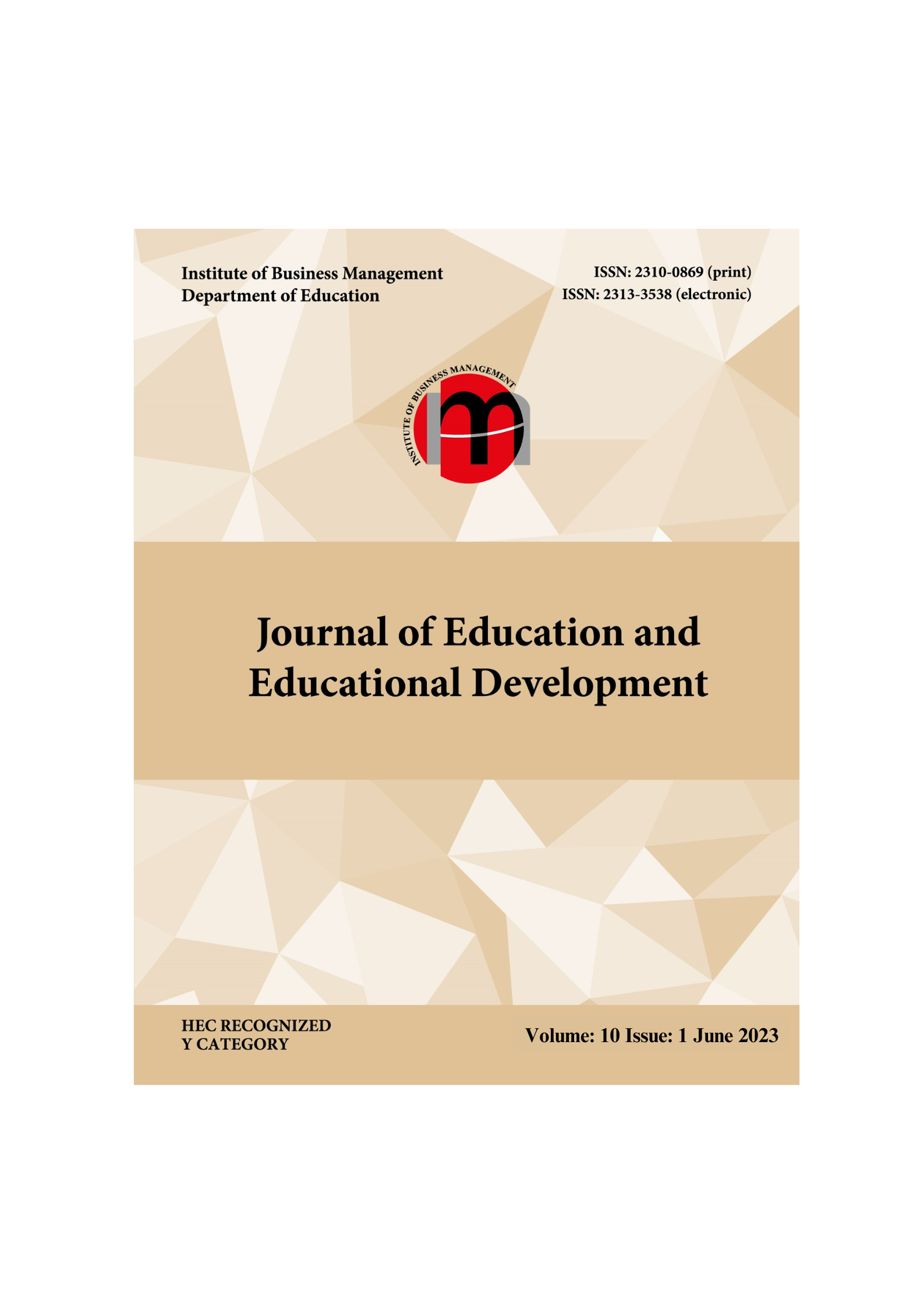
Factors Affecting Cheating Behavior at Quetta- Pakistan
DOI:
https://doi.org/10.22555/joeed.v10i1.764Keywords:
Cheating, Education, Students, Teachers, Classroom, BalochistanAbstract
Cheating in examinations across the globe is an issue of growing concern. This study argues that the culture of cheating in exams in Balochistan has reduced the efficiency of human resource and has resulted in producing students with high qualifications but less potential in the province. Therefore, it is very important
to explore the factors contributing to cheating in exams and to suggest a course of action to mitigate the menace it poses. A quantitative research method was employed for this study. Similarly, statistical techniques such as correlation and logistic regression were conducted for statistical analysis and explanation of the
study using SPSS. Theoretically, the study is inspired by rational choice theory. The findings of the study show a significant relationship between personal, institutional, and situational factors. Personal factors that contribute to cheating were found to be students’ desire to excel, low GPA, and slow learning. Institutional factors include the weak administrative role of institutions, poor academic policies, overload on students, and weak performance of the teachers. Situational factors such as the poor management strategy of the examiner, time pressure, and technological tools were found to be instigating students towards cheating. The study suggests that an appropriate exam hall setting, effective monitoring, concept-oriented exams, and a strong honor code can decrease cheating.
References
Ahmad, S. (2022). Socio-economic and Institutional factors effecting “Quality Education” in Government primary schools in the Naseerabad division, Balochistan. Journal of Development and Social Sciences, 3(II), 447–458. https://doi.org/10.47205/jdss.2022(3-ii)43
Ahmed, M., & Baloch, A. (2017). The political economy of development: A critical assessment of Balochistan, Pakistan. International Journal of Academic Research in Business and Social Sciences, 7(6). https://doi.org/10.6007/ijarbss/v7-i6/3063
Alsuwaileh, B. G., Russ-Eft, D. F., & Alshurai, S. R. (2016). Academic dishonesty: A mixed-method study of rational choice among students at the college of basic education in Kuwait. Journal of Education and Practice, 7(30), 131-159. www.iiste.org
Awdry, R., & Ives, B. (2022). International predictors of contract cheating in Higher Education. Journal of Academic Ethics, 1–20. https://doi.org/10.1007/S10805-022-09449-1/TABLES/8
Bouville, M. (2009). Why is cheating wrong? Studies in Philosophy and Education 2009 29:1, 29(1), 67–76. https://doi.org/10.1007/S11217-009-9148-0
Bushway, A., & Nash, W. R. (1977). School cheating behavior. Review of Educational Research, 47(4), 623–632. https://doi.org/https://doi.org/10.3102/00346543047004623
Cizek, G. J. (2004). Directing and preventing classroom cheating: Promoting integrity in assessment. In P. C. Rachel Livey (Ed.), Choice Reviews Online (Vol. 41, Issue 08). Corwin Press. https://doi.org/10.5860/choice.41-4791
Colnerud, G., & Rosander, M. (2009). Academic dishonesty, ethical norms and learning. Http://Dx.Doi.Org/10.1080/02602930802155263, 34(5), 505–517. https://doi.org/10.1080/02602930802155263
Denisova-Schmidt, E. (2020). Cheating among Students: Remedies and Measures. Corruption in Higher Education, 157–161. https://doi.org/10.1163/9789004433885_024
Desalegn, A. A., & Berhan, A. (2014). Cheating on examinations and its predictors among undergraduate students at Hawassa University College of Medicine and Health Science, Hawassa, Ethiopia. BMC Medical Education, 14(1). https://doi.org/10.1186/1472-6920-14-89
Diego, L. A. B. (2017). Friends with benefits: Causes and effects of learners’ cheating practices during examination. IAFOR Journal of Education, 5(2), 121–138. https://doi.org/10.22492/ije.5.2.06
DiPietro, M. (2010). 14: Theoretical frameworks for academic dishonesty. To Improve the Academy, 28(1), 250–262. https://doi.org/10.1002/j.2334-4822.2010.tb00606.x
Forsha, S. (2021). Psychological coping strategies: Influences on academic integrity. Education, 142(1), 53–64.
Harper, R., Bretag, T., & Rundle, K. (2020a). Detecting contract cheating: Examining the role of assessment type. https://Doi.Org/10.1080/07294360.2020.1724899, 40(2), 263–278. https://doi.org/10.1080/07294360.2020.1724899
Harper, R., Bretag, T., & Rundle, K. (2020b). Detecting contract cheating: Examining the role of assessment type. https://Doi.Org/10.1080/07294360.2020.1724899, 40(2), 263–278. https://doi.org/10.1080/07294360.2020.1724899
Holden, O. L., Norris, M. E., & Kuhlmeier, V. A. (2021). Academic integrity in online assessment: A research review. Frontiers in Education, 6, 258. https://doi.org/10.3389/FEDUC.2021.639814/XML/NLM
Hu, G., & Lei, J. (2015). Chinese university students’ perceptions of plagiarism. Ethics and Behavior, 25(3), 233–255. https://doi.org/10.1080/10508422.2014.923313
Hurst, B., Ooi, Y. H., & Pedersen, L. H. (2017). A century of evidence on trend-following investing. The Journal of Portfolio Management, 44(1), 15–29. https://doi.org/10.2139/SSRN.2993026
Iqbal, Z., Anees, M., Khan, R., Ara, I., Begum, S., Rashid, A., & Farooq, H. (2021). Cheating during examinations: Prevalence, consequences, contributing factors and prevention. International Journal of Innovation, Creativity and Change, 15(6), 601–609. https://www.ijicc.net/images/Vol_15/Iss_6/15641_Iqbal_2021_E1_R.pdf
Jackson, C. J., Levine, S. Z., Furnham, A., & Burr, N. (2002). Predictors of cheating behavior at a university: A lesson from the psychology of work. Journal of Applied Social Psychology, 32(5), 1031–1046. https://doi.org/10.1111/J.1559-1816.2002.TB00254.X
Kerkvliet, J., & Sigmund, C. L. (1999). Can we control cheating in the classroom? Journal of Economic Education, 30(4), 331–343. https://doi.org/10.1080/00220489909596090
Khan, W., Khan, K., & Ullah, O. (2022). Analysis of techniques used by students for unfair means in the examinations. The spark , 1(7), 109–121.
Khodaie, E., Moghadamzadeh, A., & Salehi, K. (2011). Factors affecting the probability of academic cheating school students in Tehran. Procedia - Social and Behavioral Sciences, 29, 1587–1595. https://doi.org/10.1016/J.SBSPRO.2011.11.401
Klein, H. A., Levenburg, N. M., McKendall, M., & Mothersell, W. (2006). Cheating during the college years: How do business school students compare? Journal of Business Ethics 2006 72:2, 72(2), 197–206. https://doi.org/10.1007/S10551-006-9165-7
Lancaster, T., & Clarke, R. (2017). Rethinking assessment by examination in the age of contract cheating. Plagiarism Across Europe and Beyond 2017, 215–228. https://plagiarism.pefka.mendelu.cz/seepai
Lim, V. K. G., & See, S. K. B. (2001). Attitudes toward, and intentions to report, academic cheating among students in Singapore. Ethics and Behavior, 11(3), 261–274. https://doi.org/10.1207/S15327019EB1103_5
Madara, D. S., Namango, S. S., & Katana, H. (2016). Theories and models relevant to cheating-behaviour. Online), 6(17), 2225–2484.
Makridis, O., & Englander, F. (2021). Normative revisionism about student cheating. Journal of Academic Ethics, 19(1), 1–23. https://doi.org/10.1007/S10805-020-09384-Z/METRICS
Malesky, A., Grist, C., Poovey, K., & Dennis, N. (2021). The effects of peer influence, honor codes, and personality traits on cheating behavior in a university setting., 32(1), 12–21. https://doi.org/10.1080/10508422.2020.1869006
McCabe, D. L., Treviño, L. K., & Butterfield, K. D. (2010). Cheating in academic institutions: A decade of research. 11(3), 219–232. https://doi.org/10.1207/S15327019EB1103_2
Nazir, M. S., & Aslam, M. S. (2010). Academic dishonesty and perceptions of Pakistani students. International Journal of Educational Management, 24(7), 655–668. https://doi.org/10.1108/09513541011080020/FULL/PDF
Ogilvie, J., & Stewart, A. (2010). The integration of rational choice and self-efficacy theories: A situational analysis of student misconduct. Australian and New Zealand Journal of Criminology, 43(1), 130–155. https://doi.org/10.1375/ACRI.43.1.130
Orosz, G., Farkas, D., & Roland-Lévy, C. (2013). Are competition and extrinsic motivation reliable predictors of academic cheating? Frontiers in Psychology, 4, 87. https://doi.org/10.3389/FPSYG.2013.00087/ABSTRACT
Pakistan Bureau of Statistics. (2020). Pakistan Social and Living Standards Measurement (PSLM) District Level Survey. chrome-extension://efaidnbmnnnibpcajpcglclefindmkaj/https://www.pbs.gov.pk/sites/default/files//pslm/publications/pslm_district_2019-20/PSLM_2019_20_District_Level.pdf
Pakistan Bureau of Statistics. (2021). Pakistan Social and Living Standards Measurement Survey.
Parks-Leduc, L., Guay, R. P., & Mulligan, L. M. (2021). The relationships between personal values, justifications, and academic cheating for business vs. non-business students. Journal of Academic Ethics, 20(4), 499–519. https://doi.org/10.1007/S10805-021-09427-Z/FIGURES/2
Parnther, C. (2020). Academic misconduct in Higher Education: A comprehensive review. Journal of Higher Education Policy and Leadership Studies, 1(1), 25–45. https://doi.org/10.29252/johepal.1.1.25
PPIU, SED, G. (2020). Balochistan Education Sector Plan 2020-2025.
Raman, V., & Ramlogan, S. (2020). Academic integrity and the implementation of the honour code in the clinical training of undergraduate dental students. International Journal for Educational Integrity, 16(1), 1–20. https://doi.org/10.1007/S40979-020-00058-2/TABLES/5
Ramberg, J., & Modin, B. (2019). School effectiveness and student cheating: Do students’ grades and moral standards matter for this relationship? Social Psychology of Education, 22(3), 517–538. https://doi.org/10.1007/S11218-019-09486-6/TABLES/3
Roig, M. (2017). Can undergraduate students determine whether text has been plagiarized? The Psychological Record 1997 47:1, 47(1), 113–122. https://doi.org/10.1007/BF03395215
Sattler, S., Graeff, P., & Willen, S. (2013). Explaining the decision to plagiarize: An empirical eest of the interplay between rationality, norms, and opportunity. Deviant Behavior, 34(6), 444–463. https://doi.org/10.1080/01639625.2012.735909
Sayed, N., & Lento, C. (2015). The impact of technology on academic dishonesty: Perspectives from accounting faculty. SSRN Electronic Journal. https://doi.org/10.2139/SSRN.2655615
Sheard, J., Markham, S., & Dick, M. (2010). Investigating differences in cheating behaviours of IT undergraduate and graduate students: The maturity and motivation factors. 22(1), 91–108. https://doi.org/10.1080/0729436032000056526
Shrader, C. B., Ravenscroft, S. P., Kaufmann, J. B., & West, T. D. (2012). Classroom cheating and student perceptions of ethical climate. Teaching Ethics, 13(1), 105–128. https://doi.org/10.5840/TEJ201213134
Simkin, M. G., & McLeod, A. (2009). Why do college students cheat? Journal of Business Ethics 2009 94:3, 94(3), 441–453. https://doi.org/10.1007/S10551-009-0275-X
Simpson, D. (2016). Academic dishonesty: An international student perspective. Higher Education Politics & Economics, 2(1), 5. https://digitalcommons.odu.edu/aphe/vol2/iss1/5
Tibbetts, S. G., & Myers, D. L. (1999). Low self-control, rational choice, and student test cheating. American Journal of Criminal Justice, 23(2), 179–200. https://doi.org/10.1007/BF02887271
Turner, S. P., & Beemsterboer, P. L. (2003). Enhancing academic integrity: Formulating effective honor codes. Journal of Dental Education, 67(10), 1122–1129. https://doi.org/10.1002/J.0022-0337.2003.67.10.TB03705.X
Whitley, Jr., B. E., & Keith-Spiegel. (2021). Academic dishonesty: The enemy within our gates. In Academic Dishonesty. Psychology Press. https://doi.org/10.4324/9781410604279-7
Whitley, B. E. (1998). Factors associated with cheating among college students: A review. Research in Higher Education 1998 39:3, 39(3), 235–274. https://doi.org/10.1023/A:1018724900565
Downloads
Published
Issue
Section
License
Copyright (c) 2023 Journal of Education and Educational Development

This work is licensed under a Creative Commons Attribution 4.0 International License.