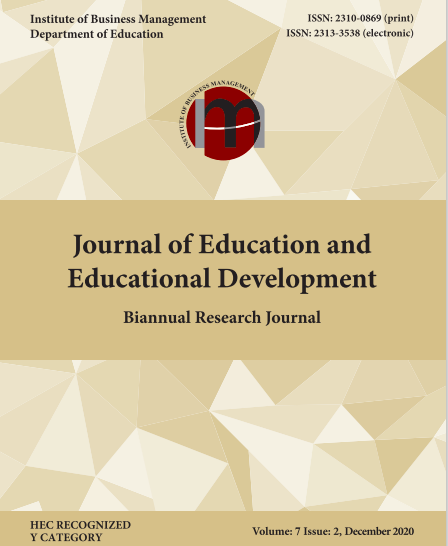
Teacher Educators’ Attitude towards the Pedagogical use of ICTs: A Study from Karachi, Pakistan
DOI:
https://doi.org/10.22555/joeed.v7i2.67Keywords:
B.Ed. program, information and communication technology, pedagogy, teachers’ attitude, teachers trainingAbstract
At present teacher education in Pakistan is in a transitional phase. The Government of Pakistan has developed ten professional standards for teachers’ recruitment and training (NPSTP, 2009). Two subjects ‘Computer literacy’ and ‘ICTs in Education’ have been introduced in the new curriculum to equip prospective teachers with Standard # 7 of NPSTP 2009 (i.e., ‘Effective Communication and Proficient Use of Information and Communication Technologies’) and to enhance contemporary technological skills required by a 21st-century educator. This quantitative descriptive study was aimed to investigate teacher educators’ attitudes towards the pedagogical use of ICTs in the teaching and learning process. For this quantitative study, five research questions, one descriptive and four inferential were formulated. A questionnaire was used for data collection. The sample of the study of 133 teacher educators’ was conveniently selected from different teacher training institutions of Karachi. The descriptive analysis of the attitude scale illustrates the moderate level of positive attitude towards the use of ICTs among teacher educators of Karachi TTIs. The analysis of
inferential questions (null hypotheses) illustrates that there is no significant difference in attitudes of teacher educators concerning gender, age, and experience, and this finding is aligned to recent studies conducted by Mustafina (2016) and Tweed (2013). Consequently, from the findings of this study, it may be concluded that demographical variables (i.e., gender, age, and experience) are not the determinants of teacher educators’ attitudes towards the use of ICTs. The findings of the study suggest that supportive conditions and hands-on training on the pedagogical use of ICTs should be conducted in TTIs.
References
Latif, Abida, (2017). Perspectives of Elementary Education. MA/ M.Ed. Course Guide (625). Allama Iqbal Open University, Islamabad. 131-152
Alharbi, Asma Mohammed, (2013). Teacher's Attitudes towards Integrating Technology: Case Studies in Saudi Arabia and the United States (Masters Theses). Grand Valley State University.
Ali, M. and Parveen, R. (2013). Teacher training: Teacher education in transition.
Retrieved from: http://ecommons.aku.edu/pakistan_ied_pdck/124
Alrasheedi, Hamed (2009). Information and Communication Technology (ICT): Effects of Gender and Training among Kuwait Teachers (Doctoral dissertation). Presented to the College of Education of Ohio University.
Al-Zaidiyeen, N. Jamil & Mei, L. Lai & Fook, F. Soon (2010). Teachers’ Attitudes and Levels of Technology Use in Classrooms: The Case of Jordan Schools. International Education Studies Vol. 3, No. 2;
Bladergroen, Moira and Chigona, Wallace (2012). Educator discourses on ICT in education: A critical analysis. International Journal of Education and Development using Information and Communication Technology (IJEDICT), 2012, Vol. 8, Issue 2, pp. 107-119.
Chai, C. Sing., & Huang-Yao Hong and Timothy Teo (2009). Singaporean and Taiwanese Pre-service Teachers' beliefs and their Attitude towards ICT use: A Comparative Study. The Asia-Pacific Education Researcher, 18(1), 117-128
Creswell, John W. (2012). Educational Research: Planning, Conducting, and Evaluating Quantitative and Qualitative Research (4th ed.). Boston: Pearson.
Dilshad, Muhammad and Iqbal, Hafiz Muhammad (2010). Quality Indicators in Teacher Education Programmes. Pakistan Journal of Social Sciences (PJSS) Vol. 30, No. 2 (December 2010), pp. 401-411
Elsaadani (2012). Teaching Staff Attitude toward ICT: Is Gender A Factor?”
International Women Online Journal of Distance Education July, 2012 Volume:1 Issue: 2 Article: 03 ISSN: 2147-0367
International Telecommunication Union (2018). Measuring the Information Society Report 2018. Retrieved from http://www.itu.int/net4/itu-d/idi/2017/index.html
Majoka. M. Iqbal, Fazal, Shawana and Khan, M Saeed (2013). Implementation of Information and Communication Technologies (ICTs) in Education Course: A Case from Teacher Education Institutions in Pakistan. Bulletin of Education and Research August 2013, Vol. 35, No. 2 (Special Issue) pp. 37-53
Ministry of Education (2009). National Professional Standard for Initial Preparation of Teachers in Pakistan. Retrieved from http://www.unesco.org.pk/education/documents/step/National%20Professional%20Standards%20for%20Teachers%20in%20Pakistan.pdf
Mustafina, Aliya. (2016). Teachers’ attitudes toward technology integration in a Kazakhstani secondary school. International Journal of Research in Education and Science (IJRES), 2(2), 322-332.
National Accreditation Council for Teacher Education (2018). List of Accredited Teachers Training Institutions and Program. Retrieved from http://www.nacte.org.pk/#/accreditation
Rana, Nishta (2012). A Study to Assess Teacher Educators' Attitudes Towards Technology Integration In Classrooms. MIER Journal of Educational Studies, Trends & Practices. November 2012, Vol. 2, No. 2 pp. 190-205
Rogers, E. M. (1995). Diffusion of Innovations (4th Ed.). New York: The Free Press.
Downloads
Published
Issue
Section
License
Copyright (c) 2020 Journal of Education and Educational Development

This work is licensed under a Creative Commons Attribution 4.0 International License.